

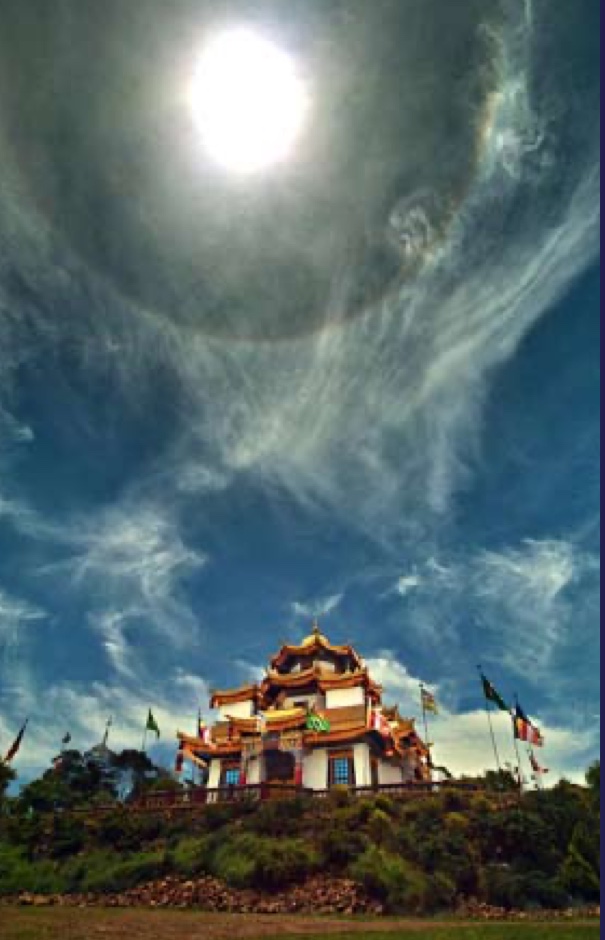
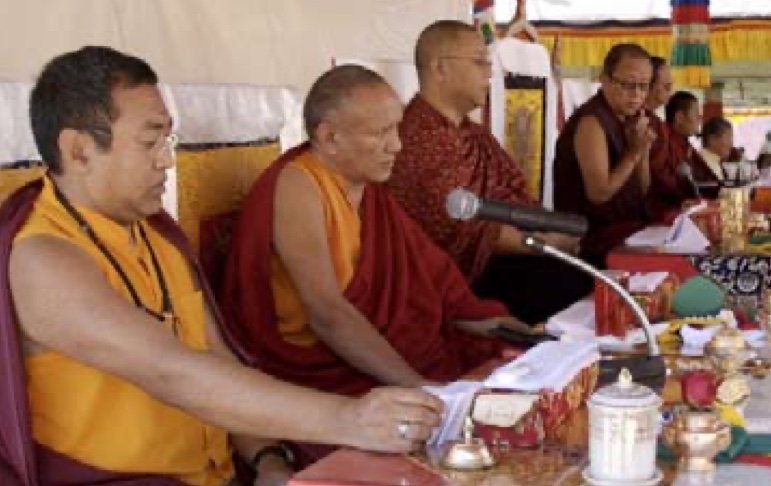
H.E. Chagdud Rinpoche’s aspiration to build a Zangdok Palri was fulfilled in December with the completion and consecration of the Padmasambhava Pureland Palace at Khadro Ling in southern Brazil. Undertaken by Chagdud Khadro soon after Rinpoche’s parinirvana, this vast project unfolded as an expression of her devotion and her dedication to upholding his dharma activities. The festive three-day ceremony was made particularly auspicious by the attendance of several precious lineage masters, whom Khadro had invited to preside over the consecration. These special guests included H.E. Dzongsar Khyentse Rinpoche, Dzigar Kongtrul Rinpoche, Jigme Khyentse Rinpoche, Tulku Sang-ngak Rinpoche, Orgyen Topgyal Rinpoche, Jigme Tromge Rinpoche, and Lopon Nyingku-la. Also present were a number of lamas, monks, and nuns and more than 500 dharma practitioners, who participated in the ceremony, listened to teachings, and celebrated the merit and blessings of this superb accomplishment.
That this exquisite representation of Guru Rinpoche’s palace, painstakingly designed, built, and ornamented by some of the finest artisans from Asia, could have arisen on a hillside field in the Brazilian countryside is amazing enough. But even more incredible is the fact that Chagdud Rinpoche’s wish to build such a palace came to fruition six years after his parinirvana.
Rinpoche had mentioned to his students that he would like to complete the project during his lifetime. But in his final years, as he developed Khadro Ling as a dharma center, teaching, conducting retreats, and undertaking many other building projects, he seemed to know that he wouldn’t have enough time. But he did choose a site, and thought about the building plans and the layout of the statues the palace would house, before he passed away in November 2002. In fact, Rinpoche spent his final few days sculpting the Amitabha statue now located on the top, or dharmakaya, level of the palace.
At one point during the ceremony, Dzongsar Khyentse Rinpoche commented that this extraordinary accomplishment would never have been possible without the unwavering devotion and commitment of Chagdud Khadro and the sangha, who dedicated all of their energy to fulfilling Chagdud Rinpoche’s wishes. Khyentse Rinpoche spoke about how difficult it can be for a sangha to continue to work together and hold their lama’s dharma activity once the lama has passed on. But he observed that by taking on this project and seeing it through to its completion, the sangha has ensured the continuation of Chagdud Rinpoche’s legacy. In fact, not only have the many dharma activities he established been maintained, but as Khyentse Rinpoche noted, they have continued to increase.
The groundwork leading up to the final days of the project took years of unwavering effort on the part of a great many individuals—South Americans, North Americans, Bhutanese, Nepalese, Tibetans, artists, lamas, dharma practitioners, and construction workers, who visualized, designed, built, and ornamented the physical structure and its contents. Hearing just a few of the stories about the logistics involved in such an undertaking, one cannot help but be amazed by what was accomplished. By relying on their practice and by uniting their aspirations to see the project through, the sangha was able to overcome each hurdle, one by one. A number of the rinpoches present at the consecration stressed how important it is for a sangha to be harmonious and commented that the harmony between individuals at Khadro Ling was quite palpable to them.
In the days following Chagdud Rinpoche’s parinirvana, it was Chagdud Khadro who envisioned going forward with the project, and it was she who provided the oversight necessary to keep it rolling. And in her endearing salt-of-the-earth way, she waded out into the mud, garden tools in hand, and took on the daunting task of landscaping the palace grounds, planting and shaping the hillside. One sangha member proudly described to us how, when Khadro reached bedrock, she carefully washed each of the stones and turned them into a rock garden.
At one point during the proceedings, Khadro made a reference to “our own Lama Rigdzin Samdrub,” who came to Brazil to help at Dzongsar Khyentse Rinpoche’s request and was integral to the preparations at all stages of the palace project. Although Lama Rigdzin adopted a very humble profile during the ceremony, it was obvious, in the way that Khadro and the other lamas, chöpöns (shrine keepers), and sangha members looked to him for guidance, that he had played a key role throughout the process.
Chagdud Rinpoche used to say that whenever you attempt to accomplish something positive or virtuous, you can expect some obstacles to arise and that with big projects the obstacles are often equally big. The groundwork for the palace involved a number of specific pujas, performed over several years by lamas and by dedicated sangha members in order to accumulate merit, bless the land, remove hindrances to the project, and ensure its swift completion. In particular, Khadro Ling has upheld annual Vajrakilaya and Essence of Siddhi drupchens, elaborate ceremonies involving a large number of practitioners and extensive offerings. This consecration ceremony was conducted in the context of the Essence of Siddhi practice, a terma cycle Chagdud Rinpoche received from the tertön H.H. Dilgo Khyentse Rinpoche in 1987.
Also present at the consecration were Lama Sonam Tsering, Lama Padma Dorje, Lama Jigme Lode, and some of the Western lamas Rinpoche ordained—all of whom have helped to establish and maintain the continuity of drupchen practices in the West. Many of the visiting rinpoches emphasized how important it is for the future of the dharma that these drupchens continue to be held.
As someone traveling from North America who had not been back to Brazil since 2003, I felt as though the entire project had been accomplished in the blink of Rinpoche’s wisdom eye. When we first arrived, I felt a profound sense of having missed out on something. It reminded me of how, many years ago, when I would work with Rinpoche on projects late into the night, I never wanted to go to sleep for fear I might miss something. It seemed that everything Rinpoche did held some transmission. So in a way, returning to Khadro Ling was like waking up and realizing I had missed out on something quite amazing. But rather than being sad, seeing what Khadro and the sangha had accomplished, I could only feel awe, admiration, and great joy. It seems that no one in Rinpoche’s sangha, which extends across almost every continent, was left out of this project. If everyone who contributed something had been physically present, the crowd could have spread to the property boundaries and beyond.
Visually, the palace is stunning. As part of the ceremony, the entire assembly circumambulated the temple and palace in an extensive procession, playing music, throwing multicolored rice, wending its way up the hill and around the palace, into the ground floor, and then up through the next two levels. To enter the palace of Guru Rinpoche is a highly personal experience—no words can suffice to describe the shift that happens in one’s heart upon seeing the interior rooms, statues, and Chagdud Rinpoche’s reliquary stupa.
On the final day, ritual dances of the Eight Emanations of Guru Rinpoche were performed in front of the palace. These dances have become an integral part of the drupchen ceremonies in Brazil, and great efforts have gone into training the dancers, as well as creating the elaborate masks, robes, and implements. It was very important to Rinpoche that the dance lineage continue, and he designed many of the costumes himself. The ceremony concluded with advice from both Dzongsar Khyentse Rinpoche and Orgyen Topgyal Rinpoche, who alternated light (and more than a touch irreverent) humor with some very weighty heart advice concerning the future of the dharma.
The event was recorded by a number of film and TV crews, as well as sangha photographers. It included speeches by a governor and a mayor and an appearance by local schoolchildren, who made individual vows to protect the environment. The Brazilian sangha danced the samba, and musicians burst into song at the end of the sessions. Hopefully, a documentary will be made to chronicle the events of those days and the profound teachings that provided such focus for everyone, for it is impossible to capture with mere words the exquisite detail of the artwork, the colors, and the flags, all set beneath the brilliant nuances of the Brazilian sky.
Khadro Ling has already had a positive impact on many people. For a few years, tour buses traveling to Gramado from Porto Alegre have regularly wound up the hill to Khadro Ling for people to see the statues, stupas, prayer wheels, butter lamps, and the temple. Now there is also the palace, brilliant gold, adorned with silks, painted in a rainbow palette, and filled with precious statues. The more people who visit this place, who circumambulate it, and offer prayers there, the more powerful the blessings will become.
The morning after the ceremony, after Tara puja, I walked up the path to the palace to take some photos. By then, many of the rinpoches had left Khadro Ling and were heading down the mountain—dispersing to different parts of the world. The huge tent was empty except for some scattered rice. The palace glowed in the morning light. Although the consecration was over, it seemed that the magic was just beginning. All I could think of was Chagdud Rinpoche and his immense kindness in making the dharma available, in such a pure way, to so many beings.
— Lama Trinley, Dechhen Ling
For more images of the consecrations at Khadro Ling and Odsal Ling, these online photo galleries were published with the original issue: picasaweb.google.com/consecrations2008, pbase.com/emmanuelgo/odsal_ling_dec_2008, and pbase.com/emmanuelgo/khadro_ling_dec_2008.
H.E. Chagdud Rinpoche’s aspiration to build a Zangdok Palri was fulfilled in December with the completion and consecration of the Padmasambhava Pureland Palace at Khadro Ling in southern Brazil. Undertaken by Chagdud Khadro soon after Rinpoche’s parinirvana, this vast project unfolded as an expression of her devotion and her dedication to upholding his dharma activities. The festive three-day ceremony was made particularly auspicious by the attendance of several precious lineage masters, whom Khadro had invited to preside over the consecration. These special guests included H.E. Dzongsar Khyentse Rinpoche, Dzigar Kongtrul Rinpoche, Jigme Khyentse Rinpoche, Tulku Sang-ngak Rinpoche, Orgyen Topgyal Rinpoche, Jigme Tromge Rinpoche, and Lopon Nyingku-la. Also present were a number of lamas, monks, and nuns and more than 500 dharma practitioners, who participated in the ceremony, listened to teachings, and celebrated the merit and blessings of this superb accomplishment.
That this exquisite representation of Guru Rinpoche’s palace, painstakingly designed, built, and ornamented by some of the finest artisans from Asia, could have arisen on a hillside field in the Brazilian countryside is amazing enough. But even more incredible is the fact that Chagdud Rinpoche’s wish to build such a palace came to fruition six years after his parinirvana.
Rinpoche had mentioned to his students that he would like to complete the project during his lifetime. But in his final years, as he developed Khadro Ling as a dharma center, teaching, conducting retreats, and undertaking many other building projects, he seemed to know that he wouldn’t have enough time. But he did choose a site, and thought about the building plans and the layout of the statues the palace would house, before he passed away in November 2002. In fact, Rinpoche spent his final few days sculpting the Amitabha statue now located on the top, or dharmakaya, level of the palace.
At one point during the ceremony, Dzongsar Khyentse Rinpoche commented that this extraordinary accomplishment would never have been possible without the unwavering devotion and commitment of Chagdud Khadro and the sangha, who dedicated all of their energy to fulfilling Chagdud Rinpoche’s wishes. Khyentse Rinpoche spoke about how difficult it can be for a sangha to continue to work together and hold their lama’s dharma activity once the lama has passed on. But he observed that by taking on this project and seeing it through to its completion, the sangha has ensured the continuation of Chagdud Rinpoche’s legacy. In fact, not only have the many dharma activities he established been maintained, but as Khyentse Rinpoche noted, they have continued to increase.
The groundwork leading up to the final days of the project took years of unwavering effort on the part of a great many individuals—South Americans, North Americans, Bhutanese, Nepalese, Tibetans, artists, lamas, dharma practitioners, and construction workers, who visualized, designed, built, and ornamented the physical structure and its contents. Hearing just a few of the stories about the logistics involved in such an undertaking, one cannot help but be amazed by what was accomplished. By relying on their practice and by uniting their aspirations to see the project through, the sangha was able to overcome each hurdle, one by one. A number of the rinpoches present at the consecration stressed how important it is for a sangha to be harmonious and commented that the harmony between individuals at Khadro Ling was quite palpable to them.
In the days following Chagdud Rinpoche’s parinirvana, it was Chagdud Khadro who envisioned going forward with the project, and it was she who provided the oversight necessary to keep it rolling. And in her endearing salt-of-the-earth way, she waded out into the mud, garden tools in hand, and took on the daunting task of landscaping the palace grounds, planting and shaping the hillside. One sangha member proudly described to us how, when Khadro reached bedrock, she carefully washed each of the stones and turned them into a rock garden.
At one point during the proceedings, Khadro made a reference to “our own Lama Rigdzin Samdrub,” who came to Brazil to help at Dzongsar Khyentse Rinpoche’s request and was integral to the preparations at all stages of the palace project. Although Lama Rigdzin adopted a very humble profile during the ceremony, it was obvious, in the way that Khadro and the other lamas, chöpöns (shrine keepers), and sangha members looked to him for guidance, that he had played a key role throughout the process.
Chagdud Rinpoche used to say that whenever you attempt to accomplish something positive or virtuous, you can expect some obstacles to arise and that with big projects the obstacles are often equally big. The groundwork for the palace involved a number of specific pujas, performed over several years by lamas and by dedicated sangha members in order to accumulate merit, bless the land, remove hindrances to the project, and ensure its swift completion. In particular, Khadro Ling has upheld annual Vajrakilaya and Essence of Siddhi drupchens, elaborate ceremonies involving a large number of practitioners and extensive offerings. This consecration ceremony was conducted in the context of the Essence of Siddhi practice, a terma cycle Chagdud Rinpoche received from the tertön H.H. Dilgo Khyentse Rinpoche in 1987.
Also present at the consecration were Lama Sonam Tsering, Lama Padma Dorje, Lama Jigme Lode, and some of the Western lamas Rinpoche ordained—all of whom have helped to establish and maintain the continuity of drupchen practices in the West. Many of the visiting rinpoches emphasized how important it is for the future of the dharma that these drupchens continue to be held.
As someone traveling from North America who had not been back to Brazil since 2003, I felt as though the entire project had been accomplished in the blink of Rinpoche’s wisdom eye. When we first arrived, I felt a profound sense of having missed out on something. It reminded me of how, many years ago, when I would work with Rinpoche on projects late into the night, I never wanted to go to sleep for fear I might miss something. It seemed that everything Rinpoche did held some transmission. So in a way, returning to Khadro Ling was like waking up and realizing I had missed out on something quite amazing. But rather than being sad, seeing what Khadro and the sangha had accomplished, I could only feel awe, admiration, and great joy. It seems that no one in Rinpoche’s sangha, which extends across almost every continent, was left out of this project. If everyone who contributed something had been physically present, the crowd could have spread to the property boundaries and beyond.
Visually, the palace is stunning. As part of the ceremony, the entire assembly circumambulated the temple and palace in an extensive procession, playing music, throwing multicolored rice, wending its way up the hill and around the palace, into the ground floor, and then up through the next two levels. To enter the palace of Guru Rinpoche is a highly personal experience—no words can suffice to describe the shift that happens in one’s heart upon seeing the interior rooms, statues, and Chagdud Rinpoche’s reliquary stupa.
On the final day, ritual dances of the Eight Emanations of Guru Rinpoche were performed in front of the palace. These dances have become an integral part of the drupchen ceremonies in Brazil, and great efforts have gone into training the dancers, as well as creating the elaborate masks, robes, and implements. It was very important to Rinpoche that the dance lineage continue, and he designed many of the costumes himself. The ceremony concluded with advice from both Dzongsar Khyentse Rinpoche and Orgyen Topgyal Rinpoche, who alternated light (and more than a touch irreverent) humor with some very weighty heart advice concerning the future of the dharma.
The event was recorded by a number of film and TV crews, as well as sangha photographers. It included speeches by a governor and a mayor and an appearance by local schoolchildren, who made individual vows to protect the environment. The Brazilian sangha danced the samba, and musicians burst into song at the end of the sessions. Hopefully, a documentary will be made to chronicle the events of those days and the profound teachings that provided such focus for everyone, for it is impossible to capture with mere words the exquisite detail of the artwork, the colors, and the flags, all set beneath the brilliant nuances of the Brazilian sky.
Khadro Ling has already had a positive impact on many people. For a few years, tour buses traveling to Gramado from Porto Alegre have regularly wound up the hill to Khadro Ling for people to see the statues, stupas, prayer wheels, butter lamps, and the temple. Now there is also the palace, brilliant gold, adorned with silks, painted in a rainbow palette, and filled with precious statues. The more people who visit this place, who circumambulate it, and offer prayers there, the more powerful the blessings will become.
The morning after the ceremony, after Tara puja, I walked up the path to the palace to take some photos. By then, many of the rinpoches had left Khadro Ling and were heading down the mountain—dispersing to different parts of the world. The huge tent was empty except for some scattered rice. The palace glowed in the morning light. Although the consecration was over, it seemed that the magic was just beginning. All I could think of was Chagdud Rinpoche and his immense kindness in making the dharma available, in such a pure way, to so many beings.
— Lama Trinley, Dechhen Ling
For more images of the consecrations at Khadro Ling and Odsal Ling, these online photo galleries were published with the original issue: picasaweb.google.com/consecrations2008, pbase.com/emmanuelgo/odsal_ling_dec_2008, and pbase.com/emmanuelgo/khadro_ling_dec_2008.


